Quick answer: Work through four things in order: what you will be doing in them, your calf measurement, the length you need, and the fabric you prefer. Get those right and almost any well-made sock will suit you; get the calf wrong and none of them will.
Ten years of shifts taught me that the "best" sock is a question people answer backwards. They start with brands and end up with something that does not fit.
Question one: what are you doing in them?
This changes everything downstream, and it is the question shops rarely ask.
Sitting still for hours - flights, coaches, long drives, a desk day that runs late. Knee-high, breathable - the flights and travel range.
Standing all day - nursing, teaching, kitchens, retail, warehouses. Knee-high, durable, and enough pairs to rotate - the work range.
Running or training - a closer fit and often a calf sleeve rather than a full sock - the sport range.
Pregnancy - easy-on styles above all - the maternity range.
Question two: what is your calf measurement?
The number that decides comfort, and the one most people never take.
Measure the widest part of your calf, first thing in the morning, standing up, with the tape snug but not pulled tight. Write it down. That number, not your shoe size, is what you buy to.
If you fall between two sizes, go up. A slightly generous calf is comfortable all day; a slightly tight one is a nuisance by lunchtime - the sizing and fit guide covers it properly.
Question three: which length?
Knee-high is the default and the right first purchase for almost everybody. It covers the calf, which is the part that notices a long day.
Ankle and low-cut vanish inside trainers and suit warm weather, but they cover none of the calf - the ankle range.
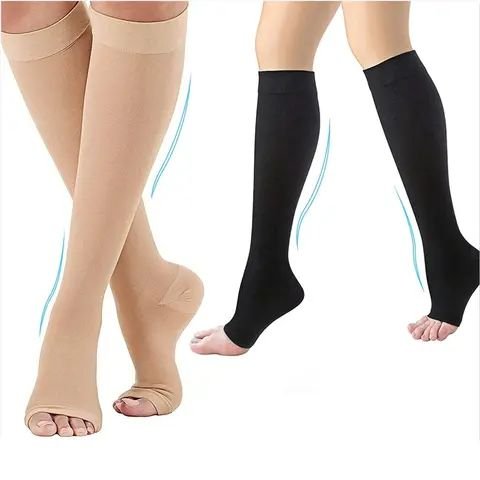
Open-toe suits anyone who dislikes something over their toes, or who runs hot - the open-toe range.
Over-knee covers more leg and is more faff. Buy it if you know you want it.
Question four: which fabric?
Now, and only now, does fibre matter.
Bamboo-rich blends feel coolest and smoothest, and suit warm environments and long wear. Cotton blends feel most familiar and suit ordinary indoor days. Nylon-rich socks last longest and hold their shape best.
Most socks are a blend of all three, and the headline fibre tells you what sits against your skin - the fabric comparison goes into it.
What not to choose by
The mmHg number. A higher figure is firmer, not better, and for everyday comfort wear firmer is usually worse - the mmHg guide explains.
Price alone. A cheap sock that fits beats a dear one that does not - the spending guide covers it.
What worked for someone else. Their calf is not your calf.
How many to buy first time
One pair. Wear it for a week of the days you actually bought it for, then buy the multipack in the size you now know works.
Buying six of the wrong size is the most common way people waste money here - the multipacks are worth it once you know your size.
Can you get them on?
The question that decides whether any of this matters. A snug sock takes grip, two hands and the ability to fold forward.
If that is difficult - a bad back, stiff hands, a bump in the way - go to a zip-up straight away rather than persevering for six months - the zip-up range covers those, and the comparison is honest about the trade-offs.
Do you like the look of them?
Not a trivial point. Socks you find depressing get worn less, and a sock in a drawer does nothing at all.
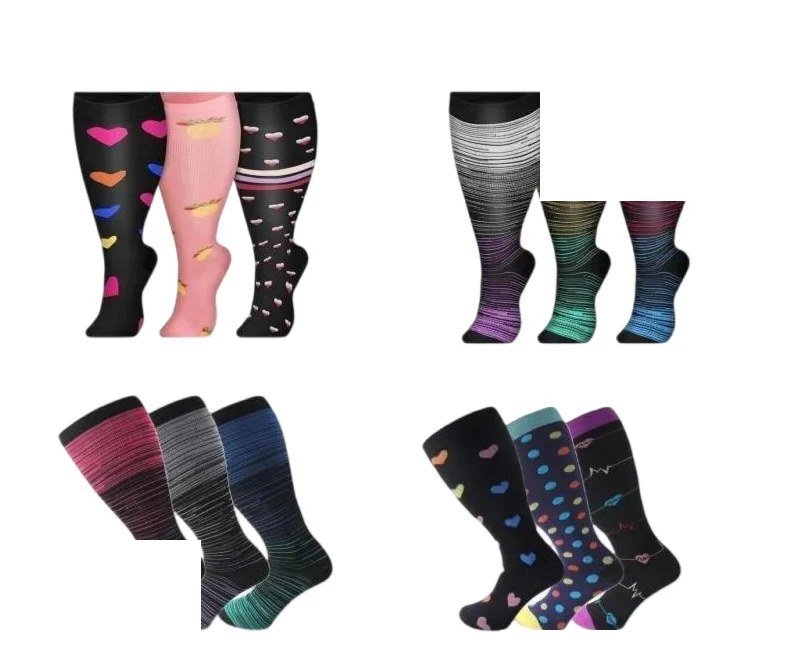
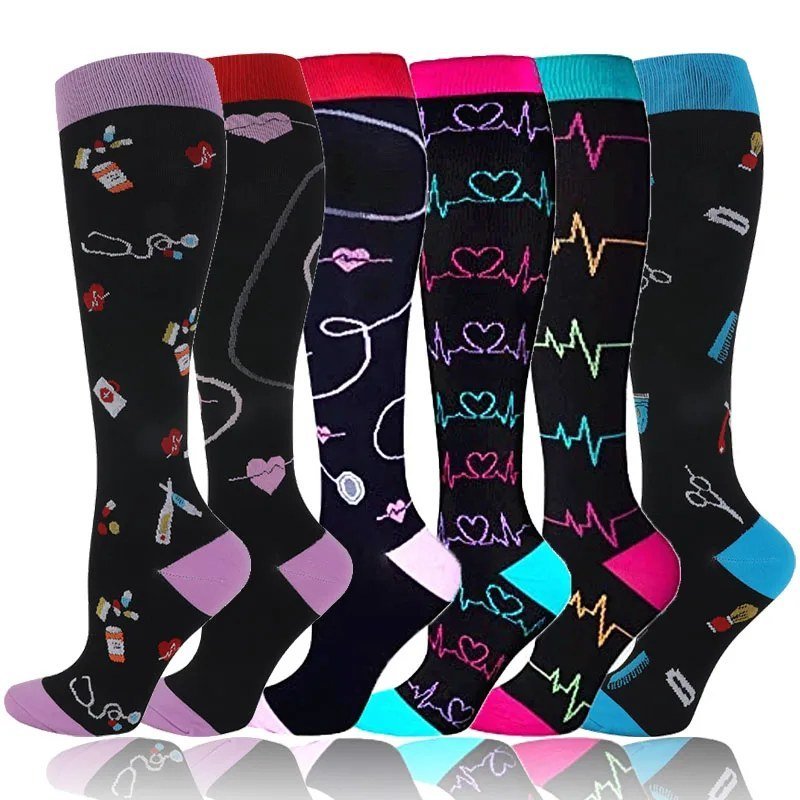
Plenty of ours are patterned and read as ordinary socks - the patterned four-pack, Midnight Patterns - and the plainer ones are properly plain - the women's range and the men's range cover both.
How to tell within a week
Wear the pair on the days you bought them for, not on quiet ones, and pay attention to three things.
Does the top band leave a groove or a faint line? Does the heel sit on your heel? And are you counting down to taking them off?
A faint line, a heel in the right place and forgetting you have them on is a pair that fits. Anything else is a sizing problem worth exchanging rather than a reason to give up on the idea - the returns page makes that easy.
What we would suggest for a first pair
Knee-high, in your measured calf size, in whatever fabric appeals, in a design you would happily wear to work. The bestsellers are the safe starting point, and there are 30 days and paid return postage if it is wrong - the returns page has the detail.
This is comfort advice, not medical advice. The complete buyer's guide has the long version.
The short version
- Answer four questions in order: use, calf measurement, length, then fabric.
- Measure the widest part of your calf in the morning and buy to that, not your shoe size.
- Knee-high is the right first purchase for almost everyone.
- Do not choose by the mmHg number - firmer is not better for everyday wear.
- Buy one pair, wear it for a week, then buy the multipack in the size you know works.
Frequently asked questions
How do I choose compression socks?
In this order: what you will be doing in them, your calf measurement, the length, then the fabric. Get those right and almost any well-made sock suits you; get the calf wrong and none of them will.
What size should I buy?
Buy to your calf measurement rather than your shoe size. Measure the widest part first thing in the morning, standing, with the tape snug but not pulled tight, and go up if you fall between two sizes.
Which length is best?
Knee-high for almost everyone, because it covers the calf, which is the part that notices a long day. Ankle styles vanish in trainers but cover no calf; open-toe suits anyone who runs hot.
Should I buy a higher mmHg for better results?
No. A higher number simply means a firmer knit - harder to put on and more likely to be uncomfortable through a long day. For everyday comfort wear, firmer is usually worse rather than better.
How many pairs should I buy to start?
One. Wear it for a week of the days you actually bought it for, then buy a multipack in the size you now know works. Buying six of the wrong size is how most people waste money here.