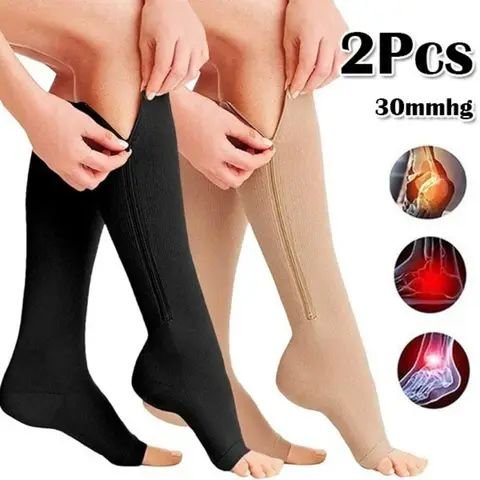
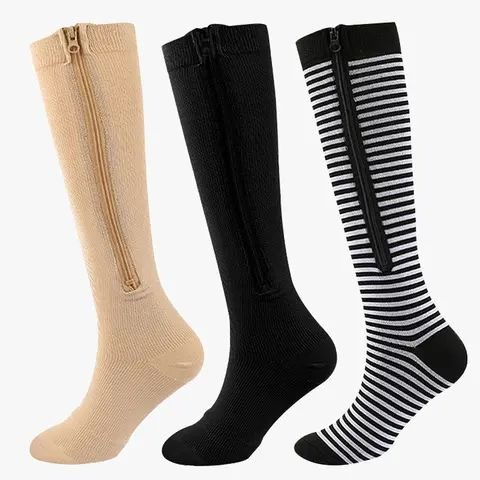
Quick answer: Pull-on socks are cheaper, smoother under shoes and last longer, but they are a genuine struggle for some people. Zip-up socks open flat so you step in rather than haul, which for anyone who cannot bend or grip easily is the difference between wearing them and not.
I spent a decade on my feet in Birmingham before I wrote about this, and I have watched plenty of colleagues give up on compression socks entirely - not because they did not help, but because getting them on at 5am was more than they could face.
The problem zips solve
A well-fitting compression sock is snug by design. Getting one on means stretching it over a heel and working it up the calf, which needs grip, two working hands and the ability to fold forward and stay there for a minute.
That is fine for most people most of the time. It is genuinely difficult if you have a bad back, arthritic hands, limited shoulder movement, a bump in the way, or you are simply doing it half-asleep before an early shift.
A zip-up opens flat down the side. You put your foot in, pull it up loosely, and close the zip. No hauling.
Where pull-on wins
Price. No mechanism, so they cost less - most of ours start at £9.99.
Under shoes. A zip is a raised line down the side of your leg. In a loose boot you will never notice; in a snug trainer you might.
Durability. A zip is the one part that can actually break, and a broken zip finishes the sock. A pull-on has nothing to fail except the elastane.
Choice. Far more colours, patterns and lengths - the knee-high range is almost all pull-on.
Where zip-up wins
Getting them on. The whole reason they exist, and it is decisive for the people it applies to.
Pregnancy, particularly the last months when reaching your feet is a project - the zip-up range covers that.
Anyone with reduced grip or movement, where a pull-on is not a mild inconvenience but a real barrier - the easy-on range covers this.
Early starts, when you want to be dressed in two minutes.
The honest trade-off
Zips add a point of failure and a raised seam, and they cost more. If you can put a pull-on sock on comfortably, there is no reason to pay for a zip you do not need.
If you cannot - or if you can but you dread it enough that some days you skip it - the zip is not a luxury. A sock you actually wear beats a better sock you do not.
Looking after a zip
A few things make the mechanism last. Close it slowly rather than yanking; a zip that catches fabric is how teeth get bent. Fasten it before washing so it cannot snag the rest of the load. And wash cool inside out like any other pair - the care and FAQs guide covers it.
Getting a pull-on on more easily
Before you conclude you need a zip, the technique is worth trying, because most people are doing it the hard way. Turn the sock inside out down to the heel, place the heel first, then roll it up the leg rather than gripping the top and hauling. Do it first thing in the morning. Rubber washing-up gloves give you grip that bare hands do not - the complete buyer's guide is worth five minutes.
Open-toe zips
Worth knowing about: you can have both. The open-toe zip sock combines the easiest entry with an open toe, which is the most forgiving combination there is for anyone who finds this difficult - the open-toe range covers the rest.
Under shoes and trousers
The practical difference in wear, and the one people underestimate.
A zip runs down the side of the leg as a raised line. Under a loose trouser leg or inside a roomy boot you will not know it is there. Inside a close-fitting trainer or a slim boot, you may feel it against the side of your ankle.
If most of your shoes are snug, that is a genuine argument for persevering with pull-ons and learning the technique instead.
Sizing a zip-up
Slightly different from a pull-on and worth knowing.
Because a zip-up closes around the leg rather than stretching over it, the calf measurement matters even more - there is no stretching-to-fit to rescue a wrong size. Measure at the widest point, and if you are between sizes on a zip-up, go up rather than down.
A zip that is straining to close is both uncomfortable and the fastest way to break the mechanism - the sizing and fit guide covers where the tape goes.
Which to buy
If you have never worn compression socks, start with a pull-on - they are cheaper, and most people manage them fine with the right technique. If you already know that bending or gripping is a problem, go straight to a zip and do not spend six months struggling first - the full range covers those, and the multipacks answers the question directly.
This is comfort advice, not medical advice. Browse the complete buyer's guide, the bestsellers or the sizing guide.
The short version
- Zips exist to solve one problem: getting a snug sock on without hauling.
- Pull-on wins on price, on smoothness under a snug shoe, and on durability.
- A zip is the one part that can break, and a broken zip finishes the sock.
- If you dread putting them on enough to skip days, a zip is not a luxury.
- Try the inside-out-to-the-heel technique before concluding you need a zip.
Frequently asked questions
Are zip-up compression socks easier to put on?
Considerably, yes. They open flat down the side, so you put your foot in, pull up loosely and close the zip rather than stretching the sock over your heel and working it up the leg.
What are the downsides of a zip?
They cost more, the zip is a raised line you might notice inside a snug trainer, and it is the one part that can actually break - a broken zip finishes the sock, where a pull-on has nothing to fail but the elastane.
Who should choose zip-up?
Anyone with a bad back, arthritic hands, limited shoulder movement or a bump in the way, and anyone who dreads putting socks on enough that some days they skip it. A sock you wear beats a better one you do not.
Can I make pull-on socks easier?
Usually. Turn the sock inside out down to the heel, place the heel first, then roll it up the leg instead of hauling from the top. Do it first thing, and rubber washing-up gloves give you grip bare hands do not.
How do I stop the zip breaking?
Close it slowly rather than yanking, since a zip that catches fabric is how teeth bend, and fasten it before washing so it cannot snag the rest of the load. Otherwise wash cool and inside out as normal.