Quick answer: mmHg is a unit of pressure describing how firmly the knit squeezes, measured at the ankle where a sock is firmest. Most everyday comfort socks sit around 15-20 mmHg. A higher number is not better - it is simply firmer, and fit matters more than either.
This is the number people ask about most and the one that tells you least on its own.
What the unit actually is
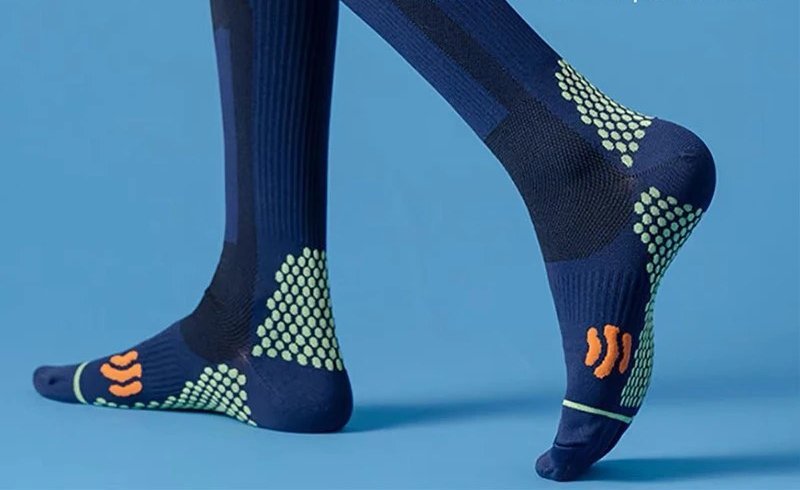
mmHg means millimetres of mercury, a standard unit of pressure. On a sock it describes how firmly the knit presses against your leg. The number is quoted at the ankle, because that is where a graduated sock is firmest - the knit then eases as it goes up the calf. That easing is the whole design idea, and it is why a knee-high has a range rather than a single figure.
What a range like 15-20 means
It is a band, not a target. A sock described as 15-20 mmHg is knitted to sit somewhere in that window at the ankle on a leg it fits. Two things follow from that.
First, it is an approximation. Where your own leg lands in the band depends on your calf and ankle, which is another reason fit matters more than the label.
Second, the range is the manufacturer's specification for the garment, not a promise about you. It describes the sock, the way a shoe size describes a shoe.
Higher is not better
The most useful thing on this page. People see a bigger number and assume a better sock, and that is not how it works. A firmer knit is simply firmer - harder to get on, more noticeable through the day, and more likely to be uncomfortable if the fit is not right.
For everyday comfort wear - a desk day, a long flight, a shift on your feet - the everyday band is where most people are comfortable and stay comfortable. That is the band we stock across the everyday range and the travel range.
What we do not do
We do not sell by clinical grade or class, and we do not stock the firmer garments that get specified by a healthcare professional. Happy Legs sells comfort and support socks. If someone has told you to wear a particular specification, buy it from a supplier who deals in that, not from us.
This is comfort advice, not medical advice.
Why fit beats the number
A sock knitted to a given band only sits in that band on a leg it actually fits. Too tight around the calf and it bites at the top regardless of what the label says. Too loose and it slides down and does very little.
That is why every guide here starts with measuring rather than with specification - the sizing and fit guide covers the two numbers, and the sizing and fit guide covers the whole thing.
How it should feel
Snug and even, firmest around the ankle, easing as it goes up. You should be aware of it when you put it on and largely forget about it an hour later.
What it should not feel like is a band biting at the top of the calf, numbness or tingling anywhere, or a sock you are counting the hours to remove. Any of those means the fit is wrong - the multipacks covers what is normal, and the complete buyer's guide covers what to do about it.
Does the number change as the sock ages?
Yes, and this is worth knowing. The elastane is what produces the squeeze, and it degrades with heat, washing and time. A pair that has been through a hot wash or a tumble dryer will be softer than the label says, which is a good practical argument for washing them cool and drying them flat - the care and FAQs guide covers it, and the care guide covers what to expect.
Why two socks with the same number feel different
A common and reasonable confusion.
Two socks quoting the same band can feel quite different, because the number describes the ankle only. How quickly the knit eases off up the calf, how wide the top band is, how thick the yarn is and how the heel is shaped all change how a sock feels in wear - and none of those appear in the specification.
That is another reason to treat the number as a rough category rather than a precise promise, and to judge a sock by wearing it.
Where you will see other numbers
You may come across firmer bands quoted elsewhere. Those are a different kind of garment, usually specified by a healthcare professional and supplied by specialist retailers rather than by a sock shop.
We do not stock them and we would not advise on them. If someone has told you to wear a particular specification, buy from a supplier who deals in that category. Nothing here is medical advice.
So what should I actually buy?
Get the size right, choose a length that suits what you are doing, pick a fabric you like, and let the specification look after itself. That order is deliberate - the complete buyer's guide walks through it, and the bestsellers covers this number specifically.
Browse the bestsellers, everyday comfort or the full range.
The short version
- mmHg is a pressure unit describing how firmly the knit squeezes at the ankle.
- A range like 15-20 is a band the garment is knitted to, not a promise about your leg.
- A higher number is firmer, not better - and harder to wear all day.
- The number only holds on a leg the sock actually fits, so sizing comes first.
- Heat and washing soften the knit over time, so wash cool and dry flat.
Frequently asked questions
What does mmHg mean on a compression sock?
Millimetres of mercury, a standard unit of pressure. On a sock it describes how firmly the knit presses, quoted at the ankle because that is where a graduated sock is firmest before easing up the calf.
Does a higher mmHg number mean a better sock?
No. A higher number simply means a firmer knit - harder to get on, more noticeable through the day and more likely to be uncomfortable if the fit is not right. For everyday wear, firmer is not better.
What does a range like 15-20 mmHg actually describe?
A band the garment is knitted to sit within at the ankle, on a leg it fits. It describes the sock rather than making a promise about your leg, much as a shoe size describes the shoe.
Why does everyone say fit matters more than the number?
Because a sock only sits in its stated band on a leg it fits. Too tight around the calf and it bites at the top whatever the label says; too loose and it slides down and does very little.
Does the firmness change over time?
Yes. The elastane produces the squeeze and it degrades with heat, washing and age, so an older pair or one that has been through a tumble dryer will be softer than the label suggests.