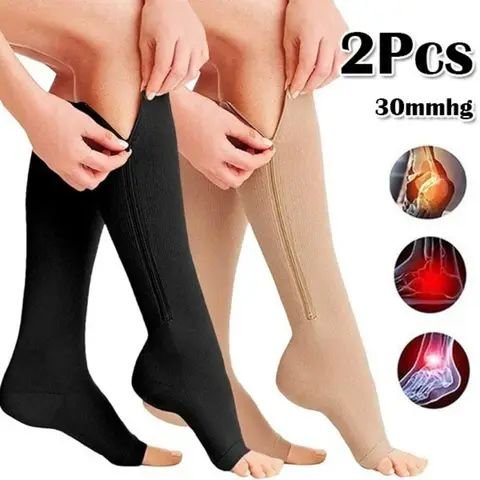
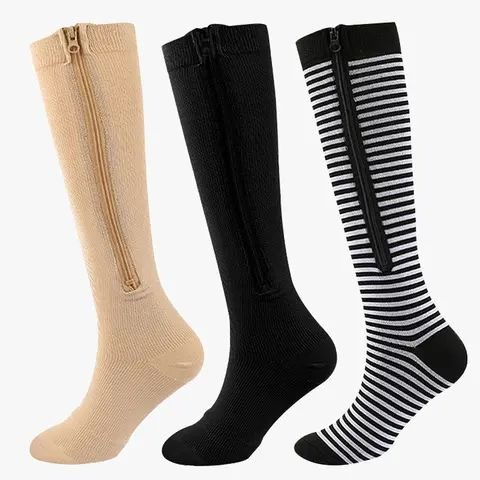
Quick answer: As bending gets harder, switch to a style that does not require it: zip-up socks that open flat, open-toe styles that slide on more easily, or footless calf sleeves that skip the foot entirely. The best sock is the one you can still put on unaided.
Somewhere around month seven both times, I discovered that the socks I owned were now theoretical. They fitted perfectly and I could not get to them.
I am not a clinician. This is about what is physically manageable, nothing more.
The problem is reach, not the sock
Worth being clear, because people assume they need a different size. Usually the sock is fine - what has changed is your ability to fold forward, hold a position and use both hands at the end of your own legs.
That means the answer is a different style rather than a different size, though it is worth re-measuring anyway - the trimester sizing guide covers what changes.
Zip-up: the straightforward answer
A zip-up sock opens flat down the side. You put your foot in, pull it up loosely, and close the zip. There is no stretching over a heel and no hauling up a leg, which are the two parts that need reach and grip.
This is what I would suggest first for anyone in the last trimester, and the people who switch to them tend to wish they had done it sooner - the zip-up range covers them, and the comparison covers the trade-offs.
Open-toe: easier than you would think
The toes are where a sock grips hardest on the way on, and an open-toe design removes that. It slides on with noticeably less effort than a closed toe.
It is also cooler, which matters if you are running warm, and it works with more kinds of shoe - the open-toe knee-high is the plain one, and the open-toe range has the rest.
Open-toe with a zip
Both at once, which is the most forgiving combination available. The open-toe zip sock is worth knowing about if you are finding everything difficult.
Footless calf sleeves
These skip the foot entirely - they cover the calf and go over whatever socks you are already wearing.
Practically, that means you can put ordinary socks on however you manage them, and add the sleeve separately. It is two items instead of one, and for some people that is much easier than one harder item.
Techniques that buy you a few weeks
Before switching styles entirely, these are worth trying.
Do it first thing, sitting on the edge of the bed, before you get up properly. Legs are smallest and you are at your least tired.
Turn the sock inside out to the heel, place the heel, then roll it up. Far easier than pulling from the top - the full method is worth reading.
Rubber washing-up gloves for grip.
A footstool, to bring your foot closer to your hands rather than folding further.
Ask for help. Everybody does eventually, and it is a fifteen-second job for somebody else.
What to avoid
Standing up to do it. Balance is different now and it is not worth it.
Rolling the top down when a sock feels tight. That concentrates everything into a band, which is the opposite of what you want. Change the size instead.
Persevering with something that is genuinely too hard. A sock you dread putting on is one you will skip on the days you most wanted it.
Slippers and around the house
Worth mentioning because it is where a lot of the day happens.
Slip-on slippers with a proper back are much easier than anything you have to bend to fasten, and safer than backless ones on stairs. If you are wearing compression socks around the house, something you can step into saves repeating the whole bending problem every time you go from carpet to a cold kitchen floor.
It is a small thing and it comes up several times a day - the everyday range covers socks for indoors.
Buy for where you will be, not where you are
If you are at twenty weeks and buying now, buy one easy-on pair alongside whatever you currently manage. You will be glad of it later, and it costs less than replacing everything at thirty-two weeks in a hurry.
Buying in stages generally is the right approach here - the maternity range covers the styles.
Taking them off
The half nobody plans for. Getting a sock off needs the same reach as getting it on.
A zip solves both ends of the problem, which is a real argument for it over an open-toe pull-on. If you are using pull-ons, roll them down from the top in stages rather than pulling from the toe.
After the birth
Reach comes back, but the early weeks involve doing things one-handed while holding a baby, which is its own constraint. An easy-on pair stays useful for a good while - the maternity range covers that stretch, and the pregnancy comfort guide covers the whole subject.
This is comfort advice, not medical advice.
The short version
- The problem is reach, not size - the answer is a different style rather than a bigger sock.
- Zip-ups open flat and close around the leg, removing the two hardest steps.
- Open-toe slides on more easily because the toes are where a sock grips hardest.
- Footless sleeves let you put ordinary socks on however you manage, then add the calf part.
- Getting them off needs the same reach as getting them on - a zip solves both ends.
Frequently asked questions
Why have my compression socks become impossible to put on?
Usually reach rather than size. The sock is fine; what has changed is your ability to fold forward, hold the position and use both hands at the end of your own legs. The answer is a different style.
Which style is easiest late in pregnancy?
Zip-up. It opens flat down the side, so you put your foot in, pull it up loosely and close the zip - no stretching over a heel and no hauling. People who switch tend to wish they had done it sooner.
Are open-toe socks easier to get on?
Noticeably. The toes are where a sock grips hardest on the way on, so removing that makes a real difference. They are also cooler if you are running warm and work with more kinds of shoe.
What are footless calf sleeves for?
They cover the calf and go over whatever socks you already have on, so you skip the foot entirely. It is two items instead of one, which for some people is much easier than one harder item.
What should I avoid doing?
Standing up to put them on, since balance is different now; rolling the top down when a sock feels tight, which concentrates pressure into a band; and persevering with something genuinely too hard to manage.