Quick answer: Turn the sock inside out down to the heel, place your heel first, then roll the rest up your leg rather than hauling from the top. Do it first thing in the morning on dry feet, and use rubber gloves if grip is the difficulty.
I spent years watching customers fight socks in a fitting room, and almost every one of them was doing the same thing wrong: gripping the top and pulling.
Why hauling from the top does not work
When you grab the cuff and pull, you are trying to stretch the entire length of the sock at once, over the widest part of your foot, with the whole thing bunched into a thick band under your fingers. The fabric fights you, your fingers slip, and the elastane takes a beating it was not designed for.
You also end up with the sock stretched unevenly, which means the graduated knit is no longer sitting where it should on your leg. So the hard way is also the way that gives you a worse fit at the end of it.
The method that works
Four steps, and it takes about twenty seconds once you have done it a few times.
One. Sit down somewhere with room, and put your hand inside the sock all the way to the heel.
Two. Pinch the heel from inside and pull the leg of the sock back over itself, so the sock is turned inside out from the heel upward. You should be left with a foot-shaped pocket and a bunched roll of fabric above it.
Three. Slide your foot into the pocket and get the heel of the sock properly onto your heel. This is the part that decides the fit, so take the extra second here.
Four. Roll the bunched fabric up your leg with both hands, working it evenly rather than pulling from one point. Do not tug the top when you get there - smooth it instead.
Timing matters more than technique
First thing in the morning, before you have been on your feet, is when this is easiest. Legs are at their smallest and the sock has the least work to do.
By the end of a long day it is a different job entirely, which is why people who put their socks on in the evening conclude they are impossible. Keep a pair beside the bed and do it before you get up properly - the sizing and fit guide covers what a good fit should feel like.
Dry feet, always
A damp foot dramatically increases the friction, and straight out of a shower is the worst possible moment. Dry properly between your toes, and if your feet are naturally clammy, a light dusting of talc makes a real difference.
Moisturiser is the other common culprit - if you use it on your feet, let it absorb completely first or the sock will simply stick.
Grip, if that is the problem
The single most useful tip and the one nobody expects: rubber washing-up gloves. They give you a grip on the fabric that bare hands cannot, and they let you work the sock up the leg smoothly instead of pinching and yanking.
They are also cheap and you probably already own a pair. Textured gardening gloves work as well.
Your fingernails and toenails
Worth its own line, because it is the most common way a new sock gets a hole in it on the first wearing.
Long or rough toenails catch the fabric from the inside as your foot goes in. Long fingernails snag it from the outside as you roll. Trim both, and use the pads of your fingers rather than the tips.
Getting them off
The reverse, and it matters more than people think. Do not pull from the toe - that stretches the foot section and does the elastane no favours.
Instead, hook your thumbs into the top, roll it down to the ankle, and then ease it off the heel and foot. Sitting down for this makes it easier and stops you hopping about.
When bending is the problem
Everything above assumes you can reach your feet comfortably. If you cannot - a bad back, stiff hips, a bump in the way, limited shoulder movement - then technique is not the answer and no amount of practice will make it one.
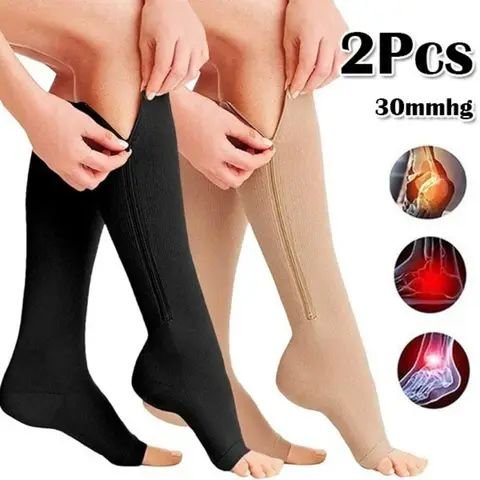
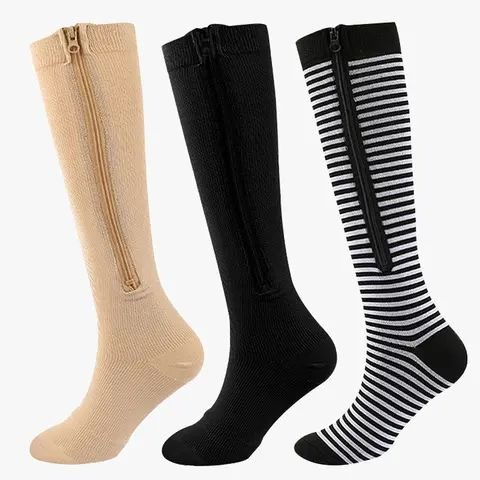
That is exactly what zip-up socks exist for. They open flat, you put your foot in, and the zip closes around the leg with no stretching involved - the zip-up range covers those, and the comparison is honest about the trade-offs.
Other things that make it easier
- An open-toe style, because your toes are not fighting the fabric on the way in - the open-toe range.
- A footless calf sleeve, which skips the foot entirely.
- Sitting on a bed rather than a low sofa, so you are not folded double.
- A pair from a multipack to practise on, rather than the pair you saved for a trip.
- A footstool to bring your foot closer to your hands.
If it is a struggle every time, check the size
Worth saying, because plenty of people persevere with a sock that is simply too small. A correctly sized sock is snug and takes a bit of effort. One that takes several minutes and leaves you out of breath is the wrong size.
Measure the widest part of your calf and check it against the chart - the wide-calf range exists for legs the standard cut does not suit. If you are between sizes, go up - the fit guide covers what is normal and what is not.
Practice on a cheap pair first
If you are new to this, learn the technique on an inexpensive pair rather than on the ones you have saved for a trip. It takes three or four goes to become automatic, and it is better to have those goes at home on a Tuesday than in a hotel room the morning of a flight.
This is comfort advice, not medical advice. Browse zip-up styles, the bestsellers or the care and FAQs guide.
The short version
- Never haul from the cuff - it fights you, damages the elastane and gives a worse fit.
- Turn the sock inside out to the heel, place the heel, then roll it up the leg.
- Do it first thing, on properly dry feet, before you have been standing.
- Rubber washing-up gloves give grip that bare hands cannot.
- If it is a struggle every time, the sock is probably a size too small.
Frequently asked questions
What is the easiest way to put compression socks on?
Turn the sock inside out down to the heel, slide your foot in and place the heel properly, then roll the bunched fabric up your leg with both hands rather than pulling from the top.
Why is pulling from the top so hard?
Because you are trying to stretch the whole sock at once over the widest part of your foot, with the fabric bunched under your fingers. It also stretches unevenly, so you end up with a worse fit as well.
When is the best time to put them on?
First thing in the morning, before you have been on your feet, when legs are at their smallest. People who try in the evening after a long day often conclude the socks are impossible.
What if I cannot grip the fabric?
Wear rubber washing-up gloves or textured gardening gloves. They give a grip on the fabric that bare hands cannot, and let you work the sock up smoothly rather than pinching and yanking at it.
What if I cannot bend down to reach my feet?
Then technique is not the answer. Use a zip-up style, which opens flat so you put your foot in and close the zip with no stretching, or a footless calf sleeve, which skips the foot entirely.