Quick answer: The early months are a standing job at unpredictable hours, so the guidance for shift workers fits better than pregnancy guidance. Choose something you can put on one-handed and quickly, keep several pairs, and get your feet up when you get the chance.
Nobody warns you that the first few months are physically a standing job. Pacing a hallway at four in the morning is not resting, whatever it looks like from outside.
I am not a clinician. This is comfort and practicality only.
Why this is closer to shift work than to pregnancy
Pregnancy guidance is mostly about reach and sizing. What you need now is different: you are upright a lot, at odd hours, often carrying something, with no predictable pattern to the day.
That is much closer to a run of night shifts, and the advice that fits is the advice for people on their feet all day - the on-your-feet guide covers those days.
Whatever you choose has to be quick
The binding constraint. If putting socks on takes three minutes and both hands, it will not happen on a morning when the day has already started badly.
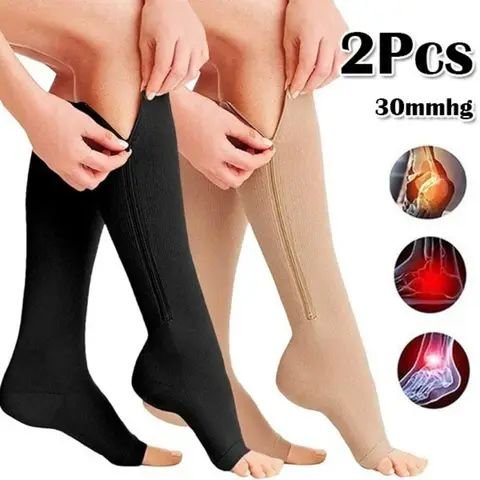
Zip-ups stay useful here for the same reason they were useful before - fast, no wrestling, manageable while distracted - the zip-up range covers those. Anything you can do sitting on the edge of a bed in under a minute is the right answer.
Re-measure
Your calf measurement may well be different from what it was in late pregnancy, and possibly different from before. A sock that fitted at thirty-four weeks may be loose now or may still be right.
Take two minutes and check rather than assuming either way - the sizing and fit guide covers where the tape goes.
Enough pairs that a clean one always exists
Laundry in the early months is relentless and rarely prioritised for adults. Two pairs means at some point you will have none.
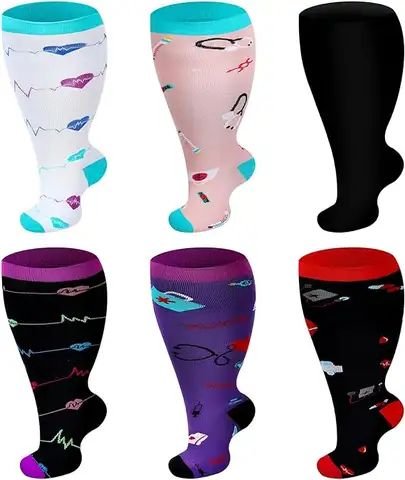
Four or five is realistic, and multipacks make that affordable rather than an indulgence - the multipacks cover it, and the spending guide covers value.
Getting your feet up, realistically
The standard advice is twenty minutes with your feet higher than your hips, which is excellent and frequently not available.
The realistic version: when you do sit down to feed or during a nap, put your feet up on something rather than leaving them on the floor. A footstool, a cushion, the arm of a sofa. It costs nothing and it turns time you were already spending sitting into time that does something.
Walking with a pram
Genuinely one of the better things available - it is movement, it is outdoors, and it frequently settles the baby.
Wear proper shoes rather than whatever is by the door, because a two-hour walk in unsupportive shoes is a two-hour walk in unsupportive shoes whatever else is going on - the everyday range covers socks for those days.
Night wakings
The bit that makes this a shift pattern. If you are up and pacing at three, you are standing at three.
Keeping a pair of socks and a pair of slippers by the bed means you are not padding about on a cold hard floor. Small, and it accumulates over weeks - Night Shift is designed for exactly the back-of-the-clock version of this.
Going back to work
If you are returning to a job on your feet, everything in the shift work guidance applies, and it is worth having the socks sorted before the first day rather than discovering the problem in week one - the twelve-hour shift guide covers running a rota.
Washing them when nothing else gets washed
Cool wash, inside out, no tumble dryer. In practice, put them in with whatever load is already going rather than treating them as a separate job - just make sure the load is a cool one.
A mesh bag stops them disappearing into the enormous volume of small items that now goes through your machine - the washing guide covers the method.
Carrying, and what it adds
The thing that makes this different from ordinary standing.
You are frequently upright while holding something, which changes how you stand and how long you can comfortably do it. Pacing a hallway holding a baby is not the same as pacing it empty-handed, and it is worth recognising that rather than wondering why an hour feels longer than it used to.
A sling helps some people simply by freeing both arms and evening out the load - the on-your-feet guide covers standing days generally.
What actually helped me
Socks by the bed. Feet up during feeds. Shoes I could put on without sitting down. A walk most days, even a short one. None of it dramatic, all of it repeatable on a bad day - which is the only test that matters at that point.
This is comfort advice, not medical advice. Browse pregnancy and maternity or the pregnancy comfort guide.
The short version
- The early months are a standing job at odd hours - shift work guidance fits better.
- Whatever you choose has to go on in under a minute, possibly one-handed.
- Re-measure your calf; it may differ from both late pregnancy and before.
- Four or five pairs, because adult laundry is not the priority in those months.
- Put your feet up on something during feeds - it turns sitting you were already doing into rest.
Frequently asked questions
Are compression socks useful after the birth?
Plenty of people carry on wearing them. The early months involve a lot of standing, pacing and walking at unpredictable hours, which is closer to a run of shifts than to pregnancy.
What style works best with a newborn?
Anything you can put on in under a minute, possibly one-handed and while distracted. Zip-ups stay useful for exactly that reason - fast, no wrestling, and manageable sitting on the edge of a bed.
Should I re-measure my calf?
Yes. Your measurement may differ from late pregnancy and possibly from before it too. A pair that fitted at thirty-four weeks may be loose now, or may still be right - it takes two minutes to check.
How many pairs do I need?
Four or five. Laundry in the early months is relentless and adult clothes are rarely the priority, so two pairs means that at some point you will have none clean.
How do I get my feet up when there is no time?
During feeds or naps, put your feet on something rather than leaving them on the floor - a footstool, a cushion, the arm of a sofa. It turns time you were already spending sitting into time that does something.