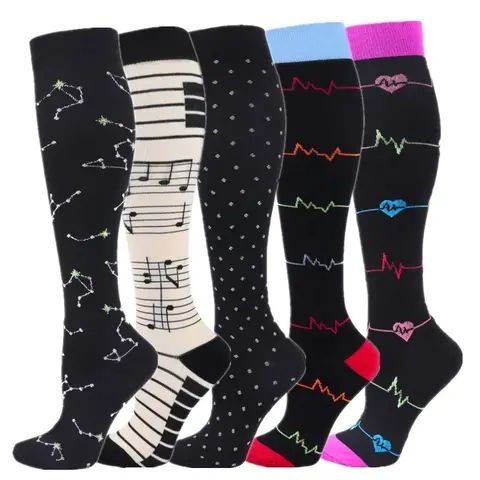
Quick answer: For a twelve-hour shift, buy knee-high in a calf width measured to your leg, own enough pairs to have a clean one every shift, and put them on before you leave home. Shoes, breaks and what you do afterwards matter as much as the socks.
I did a decade of long shifts before I wrote about them, and the thing nobody tells you is that hour eleven is not like hour three.
What a long shift is actually like for your legs
It is not really the standing. It is the standing on a hard floor, in one place, in shoes you put on twelve hours ago, with no chance to get your feet up.
Retail and hospitality floors are concrete under a thin covering. Kitchen floors are worse. Hospital corridors go on for miles. None of it is dramatic on any single hour, and all of it accumulates - the on-your-feet guide covers the day.
Put them on before you leave the house
Not in the changing room, not at handover. Legs are at their smallest first thing, which makes the sock easier to get on, and you want them on for the commute too - a bus journey or a drive before a shift is more sitting than people count.
Enough pairs to run a rota
The practical bit. A pair wants washing after every shift, and if you are working four or five in a row, two pairs will not do it.
Five pairs is a realistic number for full-time shift work. That sounds like a lot until you consider you would not wear the same work trousers five days running - the multipacks make it affordable, and the spending guide covers cost per wear.
Get the calf width right or hour eleven is unbearable
On a short day, a slightly tight sock is a niggle. On a twelve, it is all you can think about by the end, and you cannot take it off.
Measure your calf at its widest, in the morning, and go up if you are between sizes. If knee-highs have always felt tight at the top, that is a wide-calf cut you need rather than a different brand - the wide-calf range is knitted wider, and the sizing guide covers measuring.
What to look for in a shift sock
- Knee-high. The calf is what notices a long day.
- A wide, flat top band that will not groove over twelve hours.
- A decent heel, since that is where a sock worn hard fails first.
- A breathable blend, particularly in a warm environment like a kitchen.
- A colour that suits your uniform rules.
Shift Ready and Night Shift are both built for this - the work range has the rest.
Nights are different
A night shift is the same hours with worse timing. Getting the socks on before you leave still applies, but "first thing in the morning" is now the afternoon.
The bigger difference is afterwards: coming off a night, get your feet up before you sleep rather than going straight to bed, and take the socks off first.
Split shifts and doubles
The hardest version of this and the one least written about.
A split shift means two commutes, two spells on your feet and a gap in the middle that is rarely long enough to properly rest. A double is simply a very long day with a break somewhere in it.
For either, the useful move is a fresh pair of socks between the two halves if you can manage it, and getting your feet up during the gap rather than running errands - the multipacks make the second pair affordable.
What matters as much as the socks
Your shoes. Honestly, more. A well-fitting shoe with real cushioning, replaced when it is finished, is doing most of the work. Socks help; they do not rescue dead shoes.
Sitting down on your break, properly, with your feet up on something if you can. Ten minutes off your feet is worth more than a coffee.
Moving rather than standing still where the job allows it. Standing in one spot is harder than walking about.
After the shift
Take them off when you get home. Twenty minutes with your feet up higher than a chair. Then a shower.
Going straight from a twelve-hour shift to an evening of sitting on the sofa in the same socks is the version that leaves you starting the next shift already behind - the on-your-feet guide covers the whole day.
Washing them on a run of shifts
Cool wash inside out, no tumble dryer, and rotate the set rather than favouring a pair. If you are washing between shifts, remember they need time to dry - hanging them somewhere with moving air rather than on a radiator both dries them and protects the stretch - the care and FAQs guide covers it.
This is comfort advice, not medical advice.
The short version
- It is the hard floor and the not-sitting-down that accumulate, not the standing itself.
- Put them on at home - legs are smallest first thing and the commute counts.
- Five pairs is realistic for full-time shift work; you would not repeat work trousers either.
- A slightly tight sock is a niggle on a short day and unbearable by hour eleven.
- Shoes matter more than socks, and socks do not rescue shoes that are finished.
Frequently asked questions
How many pairs do I need for shift work?
Around five for full-time shifts. A pair wants washing after every shift, and working four or five in a row on two pairs does not work. It sounds like a lot until you consider you would not repeat work trousers.
When should I put them on?
Before you leave home rather than in the changing room. Legs are at their smallest first thing, which makes the sock easier to get on, and the commute before a shift is more sitting than most people count.
Why does the fit matter so much on a long shift?
Because on a short day a slightly tight sock is a niggle, and on a twelve-hour shift it is all you can think about by the end - and you cannot take it off. Measure your calf and go up if between sizes.
What helps as much as the socks?
Your shoes, honestly more - a well-fitting shoe with real cushioning, replaced when finished. Then actually sitting down on your break with your feet up, and moving about rather than standing in one spot.
What should I do after a shift?
Take them off at home, spend twenty minutes with your feet up higher than a chair, then shower. Going straight to an evening on the sofa in the same socks is how you start the next shift already behind.