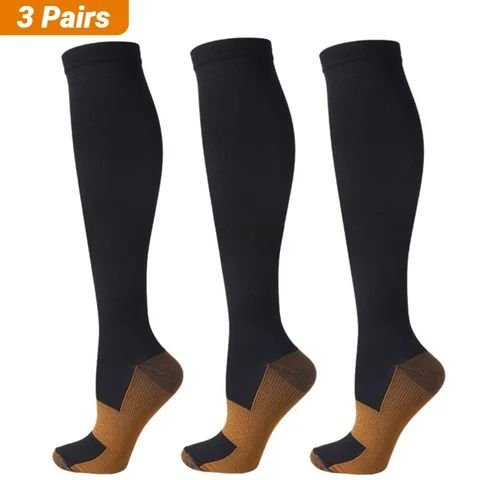
Quick answer: A long drive or coach journey involves the same hours of sitting still as a flight, so the same knee-high sock suits it. Put them on before you set off, plan proper stops rather than pushing through, and get out and walk at each one.
People think of flight socks as an aeroplane thing. The aeroplane is not the point - the sitting is, and a coach from London to Edinburgh sits you down for longer than most flights I ever worked.
Driving versus being driven
They are genuinely different journeys for your legs, and coach travel is the harder one.
A driver moves constantly, even if only a little - pedals, mirrors, shifting position, the small adjustments that never stop. A passenger on a coach does none of that. You are in one position, in a fixed seat, with limited legroom and no control over when you stop.
So if you are choosing one journey to wear them for, choose the one where you are the passenger.
Put them on before you set off
Same rule as flying, and easier to follow because you are at home with a chair. Get them on over clean dry feet before you leave, so the journey starts as it means to go on.
The alternative - a service station car park, one foot on a kerb - is nobody's idea of a good time, and you will not get them on properly.
What to wear with them
Loose trousers rather than jeans that grip the calf. Shoes you can slip off if you are a passenger, though obviously not if you are driving.
Something for your top half, because a long drive at night gets cold and the heater never gets it quite right - the flights and travel range covers the socks themselves.
Stops
The thing most people skip and the thing that helps most. Plan a proper stop every couple of hours, and make it a real one - get out, walk about, stretch your legs properly rather than standing by the door for ninety seconds while someone buys a coffee.
On a coach you get what you are given, so use every stop you are offered even if you do not need anything.
In the seat
Roll your ankles. Flex your feet. Push your heels down and lift your toes. None of it is dramatic and all of it is better than four hours of nothing.
If you are a passenger, change your position now and then rather than settling into one shape for the whole journey. If you are driving, that is what the stops are for.
Overnight coaches
The hardest version, and worth a bit of thought.
You are sitting still for a long stretch, often overnight, usually unable to sleep properly, with fewer stops than a daytime service. Wear the socks, take a layer, and get up at every opportunity the driver gives you.
A window seat is warmer and an aisle seat lets you stand more easily - on an overnight I would take the aisle every time.
Which socks
Knee-high, in a calf width measured to your leg, in a breathable blend. Exactly what you would wear to fly.
The classic knee-high three-pack is the straightforward answer and covers the return trip. Grey Stride is the plain single pair. The flight sock guide covers choosing, and it all applies here.
Getting the size right
The usual and the important bit. Measure the widest part of your calf in the morning and buy to that, going up if you fall between two sizes.
An uncomfortable pair on a six-hour coach is genuinely miserable, and there is nowhere to go - the sizing and fit guide covers measuring properly.
Long drives with children
Worth saying: children fidget constantly, which is exactly the right instinct and the reason they rarely complain about their legs on a long drive.
The adults are the ones sitting still. If you are the driver, you will feel a five-hour motorway run more than anyone else in the car, and you are the one who most needs the stops.
If you are the one carrying the bags
Worth a mention, because it changes the day.
Loading and unloading a car, carrying cases up stairs to a holiday flat and doing the driving as well makes a long journey considerably harder than the same trip as a passenger. That is the version where the socks earn their keep most, and where the twenty minutes with your feet up at the other end is worth protecting - the work range is cut for that kind of day.
Arriving
Keep them on until you have arrived and settled. If you have driven five hours to a holiday cottage, do not peel them off in the car park - get in, put the kettle on, and sit down for a bit first.
Then take them off and let your legs be for a while. A short walk once you have arrived is more useful than collapsing straight onto a sofa - the everyday range is what most people change into.
How many pairs
One for the way there and a clean one for the way back, at minimum. If you are away for a fortnight, three pairs and a wash mid-trip.
Multipacks make that cheap and mean you are not hand-washing a single pair in a holiday sink - the multipacks cover it.
If the journey is short
Under a couple of hours, most people would not bother, and that is reasonable enough. The thing worth remembering is that journeys are usually longer than the leg you are thinking about - the drive to the coach station, the wait, the journey, the walk at the other end.
This is comfort advice, not medical advice. Browse flights and travel, knee-high or the full travel guide.
The short version
- It is the sitting still that matters, not the aircraft - a long coach is harder than a flight.
- Being a passenger is harder on your legs than driving, because drivers keep moving.
- Put them on at home; a service station car park is not the place.
- Plan a real stop every couple of hours and actually walk at it.
- Take the aisle seat on an overnight coach so you can stand when you get the chance.
Frequently asked questions
Do I need compression socks for a long drive?
The same reasoning applies as for flying - it is the hours of sitting still that matter rather than the aircraft. A long coach journey or motorway drive asks much the same of your legs.
Is driving or being a passenger harder on your legs?
Being a passenger. A driver moves constantly in small ways - pedals, mirrors, shifting position - while a coach passenger sits in one position with limited legroom and no say over when the journey stops.
When should I put them on?
Before you set off, at home, over clean dry feet. The alternative is a service station car park with one foot on a kerb, where you will not get them on properly and will probably give up.
How often should I stop on a long drive?
Every couple of hours, and make it a real stop - get out and walk about properly rather than standing by the car for ninety seconds. On a coach, use every stop offered even if you do not need anything.
What can I do while seated?
Roll your ankles, flex your feet, push your heels down and lift your toes, and change position now and then rather than settling into one shape. None of it is dramatic and all of it beats four hours of nothing.