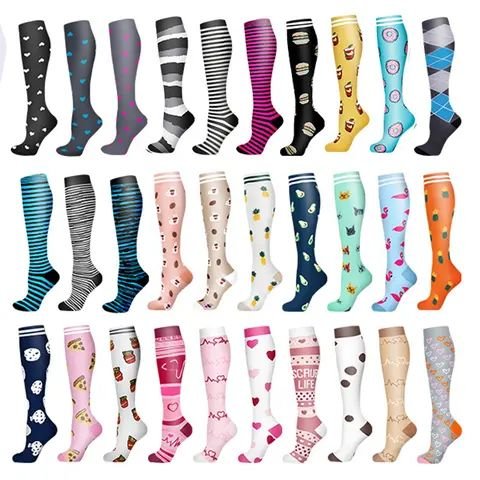
Quick answer: Plain black clears nearly every uniform policy and hides marks best. Dark patterns pass most workplaces that allow them. Beyond that, buy something you actually like, because the pair you enjoy putting on is the one that gets worn on a bad morning.
A decade of uniformed work taught me that the sock policy is rarely written down clearly. The safest answer is usually the dullest one.
Plain black is the safe answer
It passes almost every uniform policy in the country, it goes with every trouser, it does not show up under a skirt, and it hides marks better than anything else.
If you only own one kind of work sock, own this - Plain and Simple is the straightforward version and the work range has more.
What your workplace probably actually says
Policies vary but the common ones are: plain dark socks, no visible logos, nothing above the ankle showing with certain uniforms, and in food environments sometimes a requirement for closed shoes that makes sock thickness relevant.
Very few policies specify anything about what a sock is knitted like, which means a compression sock in an acceptable colour is simply a sock as far as most employers are concerned.
Dark patterns, where they are allowed
The middle ground a lot of people want. A dark patterned sock reads as smart at a glance and gives you something more interesting than black at the top of the drawer.
Midnight Patterns and Big Hearts are both dark enough to pass most policies. Hearts and Stars is the same idea.
Colour, if your workplace is relaxed
Healthcare, childcare, veterinary and plenty of hospitality settings are more relaxed than people assume, and a lot of workplaces where the rest of the uniform is strict do not care at all what is on your feet.
If that is you, this is one of the few parts of a uniform you get to choose - Pretty in Pink, Fruit and Flowers and Cat Lover all exist for that reason.
What hides a long shift best
A practical ranking, since work socks get more abuse than any others.
Black hides everything - marks, scuffs, the general state of a sock at hour eleven.
Dark patterns hide almost as much, because the pattern breaks up anything on the surface.
Mid greys and navy are fine.
White and pale colours show everything, and in a kitchen or a warehouse they look tired within weeks. They are lovely and they are not work socks.
Length, for work
Knee-high, almost always. It covers the calf, which is the part that notices a long shift. And it sits under trousers invisibly - the knee-high range covers it.
Ankle length suits warm environments and covers nothing useful, so it is a compromise rather than a choice. Footless sleeves are worth knowing about if your workplace insists on a specific sock - you wear theirs and add the calf part over it - the footless range covers those.
Buy something you like
Not a soft point. Work socks get put on at half past five in the morning by someone who does not want to be awake. The pair you find cheering is the one that gets chosen.
Within whatever your policy allows, buy the version you would pick rather than the version that feels most sensible - the everyday range covers looking normal.
Two-tone and contrast heels
A small detail that changes how smart a sock looks.
A contrast heel and toe is common on sports and everyday designs, and it reads as deliberate rather than functional. Under a trouser it is invisible either way. So it only matters if any of the sock will show - with a skirt, or when shoes come off indoors.
If your workplace is strict about a plain appearance, an all-over single colour is the safer choice - the knee-high range covers both.
Enough of them
Five pairs for a full-time week, so there is a clean one every day. Buying five of one design is fine and buying a mixed multipack is more interesting - the multipacks cover both, and the spending guide covers value.
Keeping the colour
Black fades to grey faster than people expect, particularly with hot washes and tumble drying - which you should not be doing anyway.
Cool wash inside out, no dryer, and wash darks together. A black sock washed properly stays black considerably longer, which matters when the policy says plain black - the washing guide covers the method.
Replacing them
Work socks wear out fastest of any use. When a pair goes on far more easily than it did when new, or the top band no longer sits, it is finished - the care and FAQs guide covers the signs.
Replacing the whole set at once keeps them looking uniform, which matters if the policy is strict about appearance.
If you are told they are not permitted
Worth knowing that a compression sock in the required colour is, visually, an ordinary sock. If there is a specific concern, it is worth asking what the objection is - most policies are about appearance rather than construction - the on-your-feet guide covers work days generally.
Reading a dress code that says nothing about socks
Most dress codes do not mention socks at all, which people read as either permission or prohibition depending on temperament.
In practice, silence means nobody has thought about it. The safe reading is to match the formality of the rest of the code.
If the code specifies a uniform colour for trousers or tunics, assume plain dark socks are expected and anything else is a conversation you may not want. If it says "smart" and nothing more, plain dark is still the safe default and a dark pattern is almost always fine.
Where the code genuinely matters is healthcare and food settings, where there are often rules about what is visible and washable rather than about colour. Those are worth asking about directly rather than guessing.
The useful question to ask, if you want to ask one, is not "can I wear these" but "is there anything about socks I should know". The second gets you the actual rule; the first invites a no.
And under trousers, none of it is visible anyway. The question only arises with a visible ankle.
This is comfort advice, not medical advice.
The short version
- Plain black clears nearly every policy and hides marks better than anything.
- Most policies cover colour and logos, not how a sock is knitted.
- Dark patterns are the middle ground where a workplace allows them.
- White and pale colours look tired within weeks in a kitchen or warehouse.
- Buy the pair you like - it is the one you will choose at half past five.
Frequently asked questions
What colour work socks are safest?
Plain black. It passes almost every uniform policy, goes with every trouser, does not show under a skirt and hides marks better than anything else. If you own one kind of work sock, own this.
Do uniform policies ban compression socks?
Very few say anything about how a sock is knitted - policies almost always cover colour, logos and visible length. A compression sock in an acceptable colour is simply a sock as far as most employers are concerned.
Which colours hide a long shift best?
Black hides everything, dark patterns hide almost as much because the pattern breaks up the surface, and mid greys and navy are fine. White and pale colours look tired within weeks in most workplaces.
What length should work socks be?
Knee-high almost always - it covers the calf, which is the part that notices a long shift, and sits invisibly under trousers. Ankle length is a compromise that covers nothing useful.
How do I stop black socks fading to grey?
Wash cool at 30, inside out, with other darks, and keep them out of the tumble dryer. Heat is what fades them fastest, and it is also what destroys the stretch, so it costs you twice.